I Don't Use AI to Move Faster. I Use It to Get Better
In this article
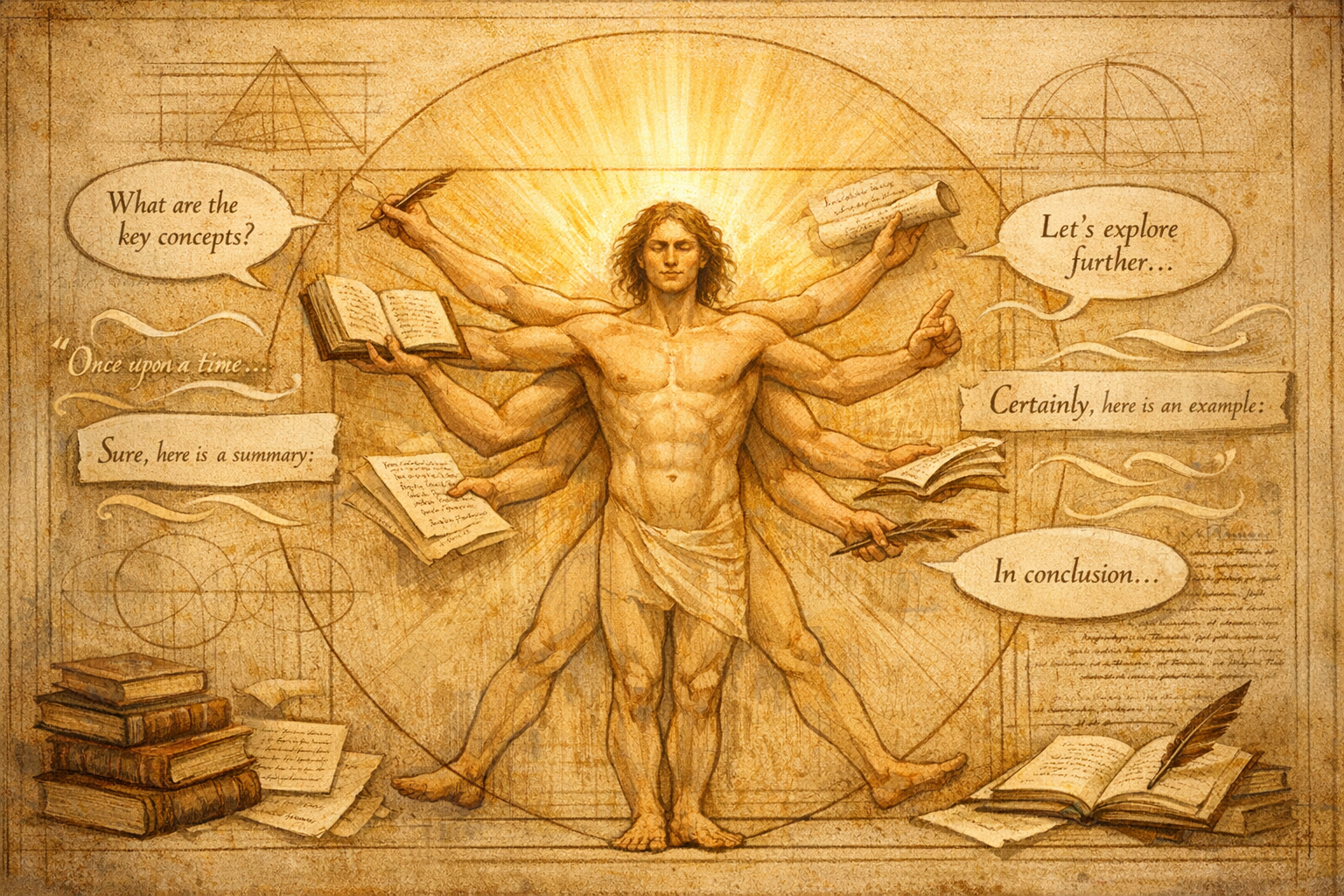
If I were to ask you how you use AI tools and agents, you would most likely tell me that you use them to automate workflows. Whether you are a professional software engineer, a PM, or a manager, you probably use AI the way most people do: to make your life easier and more productive. Productivity looks different from discipline to discipline, but the basic idea is the same.
I use AI that way too. As an engineering manager, I use agentic AI to inspect code, generate code, read and summarize documents, and create workflows for myself to be a more productive professional.
But I also use these tools in a different way. I use them as mentors, advisors, and teachers. Most importantly, I use them to become a better version of myself, personally and professionally.
That is what this post is about. Not the productivity side of AI, which is real and useful, but the growth side. The way I use AI to learn better, think better, and become better.
The Teacher I Never Had

When the first versions of ChatGPT came out, I immediately saw the potential of these tools to become the ultimate teacher. My entire life, I have been a very inquisitive and curious person. I have always liked studying new ideas, understanding concepts to their core, and connecting ideas from different disciplines through analogy or by finding common structure.
The problem I always had was that I did not have a good way to do it. Most of the teachers and professors I had were not very cooperative. They wanted to teach the material and get it over with. Some were cooperative with me, but they were the exception to the rule.
With websites like Stack Overflow and search engines, I was able to make some progress, but it required many cycles to get to a point where I felt happy with the result and felt that I had truly learned what I was looking for. In many cases, if I had follow-up questions or wanted to test different angles, I could not do it. I had to rely on someone else asking those questions and hope that the answer was out there.
Then came LLMs, and with every new model I found that the learning experience I had always looked for was becoming better and better. I could ask questions, get answers, and then keep diving deeper. I could go as deep as I wanted, then come out the other side with a different set of questions. The LLM does not need rest. It can keep going for as many tokens as I have left for that day.
When I wanted to learn math concepts that I had always wanted to understand deeply, I simply started a session with ChatGPT or Claude and asked them to teach me. I would ask questions, and when I did not understand something, I would keep pushing them to explain it from different angles until it finally clicked.
I started feeling like I was free.
Free to learn whatever I want, whenever I want. Free to unfold the mysteries of so many topics and ideas that were always floating in my head, but that I never did anything with. For me, that was a breakthrough period. A time to rejoice.
AI as a Tool for Learning How I Learn
Throughout all these conversations, I did not just learn new ideas. I realized that I could extract something much more valuable. I could ask the LLM to explain my thought process back to me.
Over time, I realized that the LLM, after serving as my teacher for so many sessions and hours, could extract a very strong signal about how my brain works, what my strengths are, and what my weaknesses are. Once I had those signals, I could ask it to generate explanations tailored directly to how my brain operates.
So after every long session with an LLM, I would ask it a final question: how would you describe my thought process? What are my strengths? What are my weaknesses?
After many such sessions, I asked the LLM to take that compilation of insights and generate a specific skill that I could use to learn anything I wanted. Today, that is the main way I learn. I feed anything that I want to learn or understand through that skill and let the LLM do its magic.
It works like a charm. For example, I once had to read a very long incident report at work during a meeting. Instead of trying to grind through the entire report on the spot, I fed it to the skill I had created. It immediately output an explanation in the exact format that helps me understand things best. Within a few minutes, I got to the crux of the matter and truly understood the issue.
It was liberating. I call it higher-order thinking.
AI as a Sparring Partner

In addition to learning new ideas, I am also very opinionated about many topics and about current events. I cannot always bounce these ideas off my friends, partly because they do not necessarily know enough about these topics, and partly because they are not always available for these kinds of discussions.
But there is another issue. I am not just looking for agreement. I am looking for pushback. I want someone to bring contrary thoughts that force me to solidify my understanding and either defend my ideas or realize that I cannot.
What better tool than an LLM to serve in that role?
I start a discussion with the LLM and basically have an entire debate with it. It brings up contrary points and tries to show me where I am missing things, and I push back with counterarguments, which force it to sharpen its own arguments too. As the debate continues, it becomes an exercise in patience and resilience, but also a test of whether my ideas are really strong and whether I am able to defend them in a systematic, logical way.
My goal is not to be right. My goal is to learn my own limitations and improve myself.
At the end of the session, I will most likely not convince the LLM of anything. But that is not the point. I ask it to analyze the debate, my thought process, and my debating skills. That is where the real growth happens.
The LLM gives me a long list of my strengths and a long list of my weaknesses. I read them carefully and try to improve. I also learn more about myself so that when I encounter similar situations in real life or at work, I can operate better based on those learnings.
AI as a Coach for Becoming a Better Person

Have you ever thought about why you react in a certain way with certain people?
If you are married, as I am, and if you have children, then you know how much friction can come with the territory. But you do not need to be married to know that you have certain buttons that, when people press them, make you react. I have noticed that in many situations in my life, whether while driving, during a disagreement with my wife, or in a conflict at work.
What if you had your own personal trainer, someone you could consult about these situations, someone with infinite patience and insight to guide you?
Lucky for us, that now exists.
I use LLMs for this purpose all the time. I have special sessions dedicated to talking through situations that happened to me over the course of a day or a week. The LLM already has a compressed context of me and can connect dots across many situations. That is where the real insights come from.
At some point, the LLM is able to construct something like a personal narrative for you. It can help you understand not only the micro, but also the macro. You stop being just a puppet reacting to the world around you. You begin to see a bigger picture.
And if you are willing to learn from that bigger picture, you gain the ability to become a better person.
That is exactly what I do on an almost daily basis.
Conclusion
The AI revolution is here to stay. It is changing every aspect of our lives, for better or worse. It is up to us, as individuals and professionals, to adapt or go extinct. For me, the choice is obvious.
But more than that, I am using these tools not just to be more efficient and more productive. I am using them to become the best version of myself. I am using them to learn faster and more effectively, as teachers that not only know the material extremely well, but also know me well enough to tailor the material to me in the exact way that I need.
I am also using them to become a more capable person, to understand my own limitations, and to find ways to bridge them.
I have never been more excited to be alive. I have never been more excited to be part of a revolution of which we still have not seen the tip of the iceberg.
Comments
Leave a Comment
Comments (0)