Rediscovering i - Chapter 1: From Numbers to Rotations
Rediscovering $i$
Chapter 1: From Numbers to Rotations
Have you ever revisited a topic you thought you understood, only to realize you didn't - not really? That's what happened to me with complex numbers. I knew how to use them algebraically, could recite their properties, apply them to problems. But I didn't understand what they were. There's a difference between knowing something and truly understanding it.
We're taught that $i = \sqrt{-1}$, which is an incomplete introduction. This equation tells you how to use $i$ - just replace $i^2$ with $-1$ and the algebra works - but it tells you nothing about what $i$ actually represents. It makes $i$ seem like a pure mathematical abstraction, a symbolic trick with no deeper meaning. Yet $i$ shows up everywhere in the physical world: in electromagnetism, quantum mechanics, signal processing. Why does the square root of a negative number need a special symbol? What does it mean?
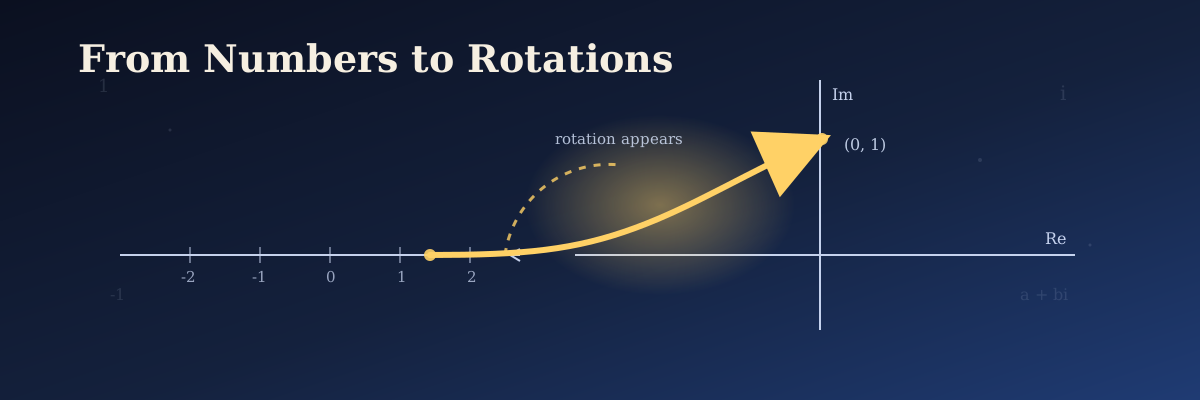
Here's the thesis: Complex numbers can be represented as 2D vectors (arrows in the plane) equipped with a multiplication rule. That's it. The symbol $i$ isn't mystical or imaginary - it corresponds to the arrow $(0, 1)$, and complex multiplication is what happens when you extend ordinary multiplication from the number line to the plane.
This post will build that understanding from scratch. We'll start with how numbers multiply on the real line, extend that pattern to two dimensions, and discover that complex numbers emerge naturally. If you're comfortable with basic high school linear algebra and a bit of trigonometry, you'll be able to follow along.
Beyond the Symbol
The equation $i = \sqrt{-1}$ tells you the mechanics - you can manipulate it algebraically - but it doesn't explain the geometry. It took 300 years from when complex numbers were first introduced until Gauss gave them a proper geometric interpretation. Let's see what that interpretation is.
Numbers as Arrows: A Vector Space Perspective
The real number line ($\mathbb{R}^1$) is a vector space. This means two fundamental operations are defined:
- Addition: Combining two vectors gives another vector (e.g., the vector for 3 plus the vector for 2 gives the vector for 5)
- Scalar multiplication: Scaling a vector by a number (e.g., 2 times the vector for 3 gives the vector for 6)
These rules might seem abstract right now, but they'll become important soon. To keep things visual, we'll use "arrows" and "vectors" interchangeably - arrows are easier to think about geometrically.
Now, going back to our number line. We can think of numbers as arrows pointing from the origin. The number 3 is an arrow from 0 to 3, and -2 is an arrow from 0 to -2.
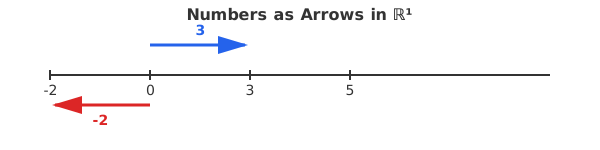
But there's something special about $\mathbb{R}^1$: beyond the standard vector space operations (addition and scalar multiplication), we can also multiply two arrows together to get another arrow. This isn't part of the standard vector space definition - it's an additional operation that $\mathbb{R}^1$ happens to have. This arrow perspective reveals what multiplication actually does geometrically.
The Key Insight: Multiplication as Scaling and Rotation
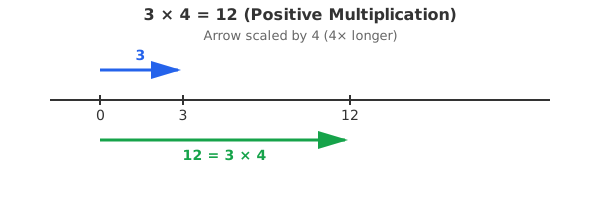
When we multiply $3 \times 4$, the arrow scales by 4 - it becomes 12 units long, still pointing right.
But what happens with $3 \times (-2)$? The result is -6, an arrow pointing 6 units to the left. The arrow didn't just scale - it rotated 180 degrees.
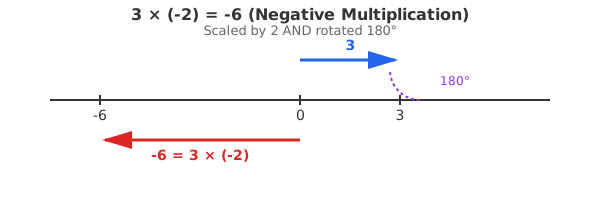
This is the pattern: multiplication scales the length and rotates the direction. On the number line, there are only two directions (left and right), so multiplying by -1 gives a 180° rotation.
But what if we had more directions? On the number line, we're limited to 0° and 180°. What if we could rotate by any angle - 90°, 45°, or any other amount? That would require moving beyond the one-dimensional number line to a two-dimensional plane where arrows can point in any direction.
Here's the question: Can we extend this multiplication pattern to two dimensions?
Comments
Leave a Comment
Comments (0)