Rediscovering i - Chapter 2: Rediscovering i
In this article
- Rediscovering $i$
- Chapter 2: Rediscovering i
- Moving to Two Dimensions
- Deriving the Multiplication Formula
- Goal: We want $r_3 = r_1 \times r_2$ with length $|r_1| \times |r_2|$ and angle $\theta_1 + \theta_2$
- The Building Blocks: Basis Vectors
- Multiplying the Basis Vectors
- The Reveal: What is $i$?
- Completing the Picture
- Final Word
- On a Personal Note
Rediscovering $i$
Chapter 2: Rediscovering i
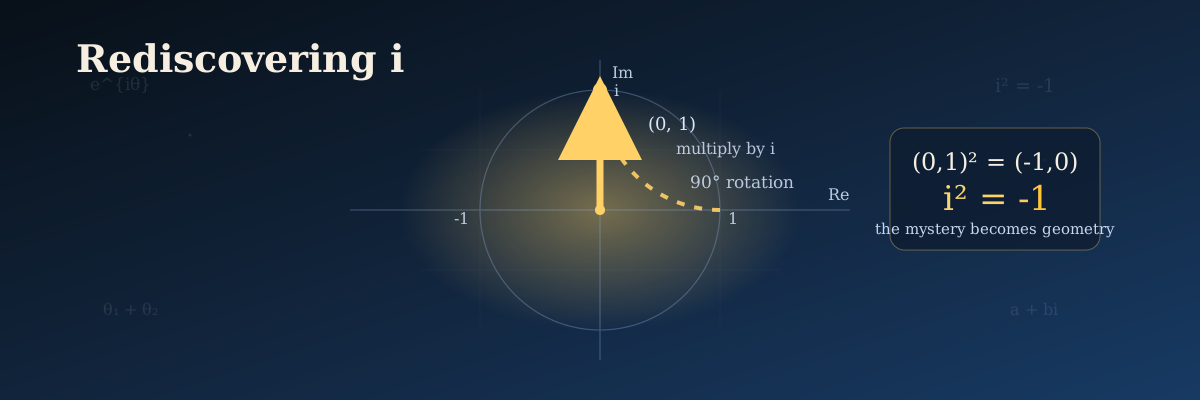
Chapter 1 established the key pattern: multiplication on the real number line does two things, it scales length and rotates direction. On the one-dimensional number line, we're limited to just two directions (0° and 180°), so multiplying by -1 gives a 180° rotation. If you'd like the setup, you can start with Chapter 1.
But we ended with a question: Can we extend this multiplication pattern to two dimensions? If multiplication means "scale length and rotate direction," what happens when arrows can point in any direction?
Let's find out.
Moving to Two Dimensions
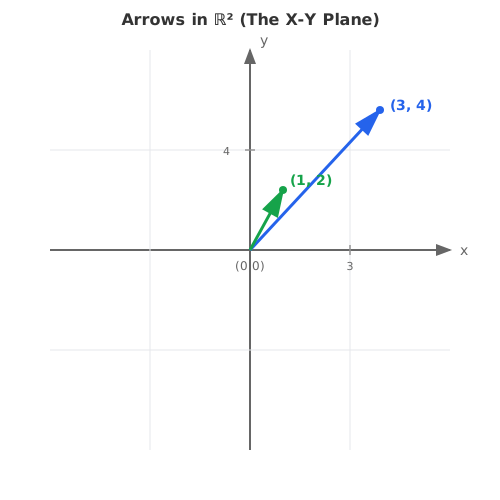
In $\mathbb{R}^2$ - the familiar X-Y coordinate plane - points like $(3, 4)$ can also be viewed as arrows from the origin.
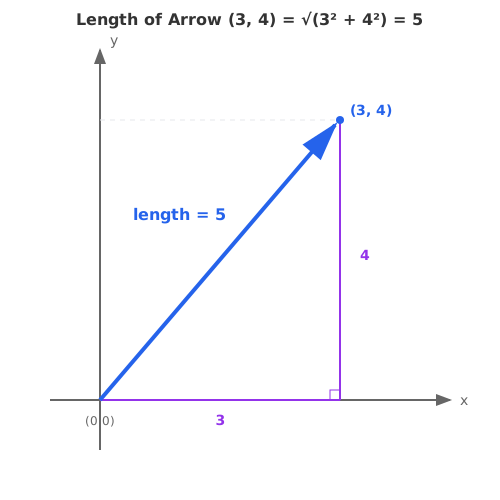
These arrows have length: the arrow $(3, 4)$ has length $\sqrt{3^2 + 4^2} = 5$.
But unlike $\mathbb{R}^1$, direction isn't limited to two choices. Arrows can point at any angle from 0° to 360°.
Can we define multiplication for these arrows that extends the pattern from $\mathbb{R}^1$? Let's think about what we need:
In $\mathbb{R}^1$, multiplying by 3 scales length by 3, and multiplying by -1 rotates by 180°. So multiplication does two things: it scales length and rotates direction.
If we want this pattern to work in $\mathbb{R}^2$, we need the same behavior. When we multiply two arrows, the result should:
- Have length equal to the product of the two lengths (if arrow 1 has length 3 and arrow 2 has length 4, the result has length 12)
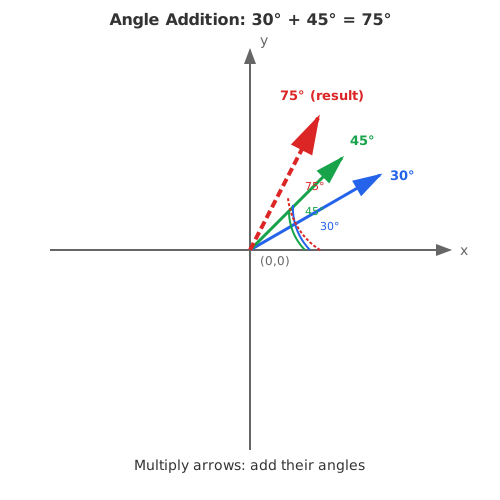
- Point in a direction that's the sum of the two angles (if arrow 1 points at 30° and arrow 2 points at 45°, the result points at 75°)
This isn't arbitrary - it's the only way to preserve the scaling-and-rotating pattern from $\mathbb{R}^1$. Let's make this precise:
- Lengths multiply: $|r_1 \times r_2| = |r_1| \times |r_2|$
- Angles add: $\angle(r_1 \times r_2) = \angle(r_1) + \angle(r_2)$
Deriving the Multiplication Formula
We have two arrows:
- Arrow $r_1 = (a, b)$ at angle $\theta_1$
- Arrow $r_2 = (c, d)$ at angle $\theta_2$
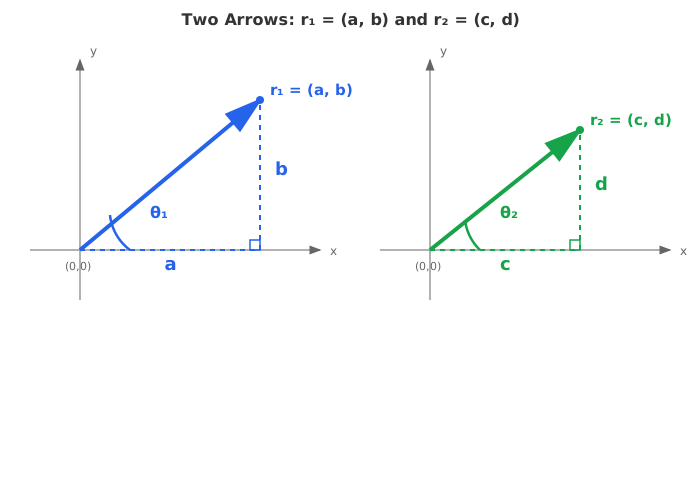
From trigonometry, coordinates relate to angles:
$$a = |r_1| \cos(\theta_1), \quad b = |r_1| \sin(\theta_1)$$
$$c = |r_2| \cos(\theta_2), \quad d = |r_2| \sin(\theta_2)$$
Goal: We want $r_3 = r_1 \times r_2$ with length $|r_1| \times |r_2|$ and angle $\theta_1 + \theta_2$
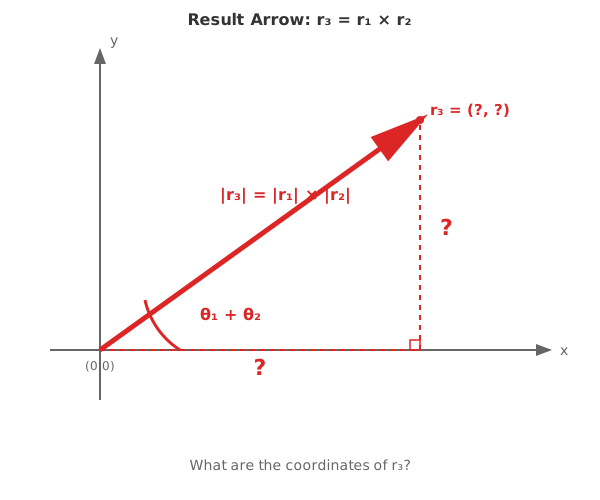
What are the coordinates of $r_3$ in terms of $a, b, c, d$?
The x-coordinate:
$$x_3 = |r_3| \cos(\theta_1 + \theta_2) = |r_1| \cdot |r_2| \cdot \cos(\theta_1 + \theta_2)$$
Using the angle addition formula $\cos(\theta_1 + \theta_2) = \cos(\theta_1)\cos(\theta_2) - \sin(\theta_1)\sin(\theta_2)$:
$$x_3 = |r_1| \cdot |r_2| \cdot [\cos(\theta_1)\cos(\theta_2) - \sin(\theta_1)\sin(\theta_2)]$$
$$= |r_1|\cos(\theta_1) \cdot |r_2|\cos(\theta_2) - |r_1|\sin(\theta_1) \cdot |r_2|\sin(\theta_2)$$
$$= ac - bd$$
The y-coordinate:
$$y_3 = |r_3| \sin(\theta_1 + \theta_2) = |r_1| \cdot |r_2| \cdot \sin(\theta_1 + \theta_2)$$
Using $\sin(\theta_1 + \theta_2) = \sin(\theta_1)\cos(\theta_2) + \cos(\theta_1)\sin(\theta_2)$:
$$y_3 = |r_1| \cdot |r_2| \cdot [\sin(\theta_1)\cos(\theta_2) + \cos(\theta_1)\sin(\theta_2)]$$
$$= |r_1|\sin(\theta_1) \cdot |r_2|\cos(\theta_2) + |r_1|\cos(\theta_1) \cdot |r_2|\sin(\theta_2)$$
$$= bc + ad$$
Therefore: $(a, b) \times (c, d) = (ac - bd, bc + ad)$
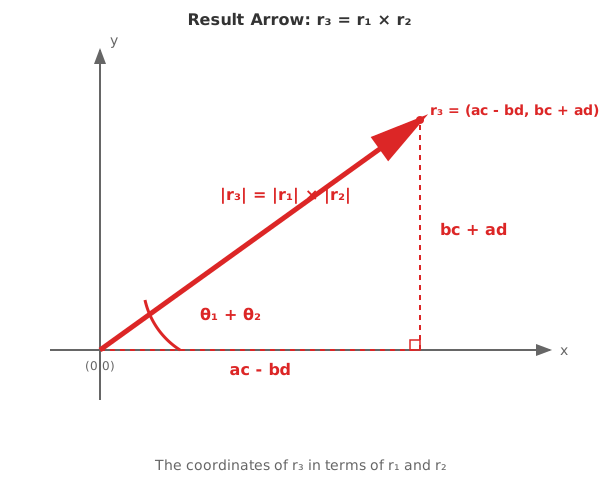
We just defined a multiplication operation on pairs of real numbers by requiring lengths to multiply and angles to add. This isn't part of the standard vector space structure - we're constructing it by extending the pattern from $\mathbb{R}^1$. This operation will turn out to match complex number multiplication perfectly, but we're building it from geometric principles. This is the bridge to complex numbers.
The Building Blocks: Basis Vectors
Two arrows are special in $\mathbb{R}^2$: $(1, 0)$ and $(0, 1)$. Every other arrow can be written as a combination of these two.
For example: $(3, 4) = 3 \cdot (1, 0) + 4 \cdot (0, 1)$, and $(-2, 3) = -2 \cdot (1, 0) + 3 \cdot (0, 1)$.
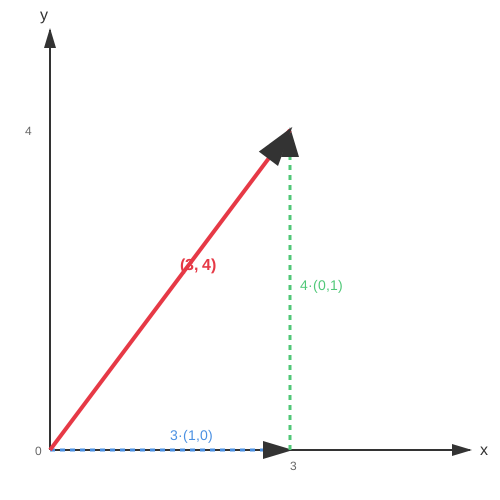
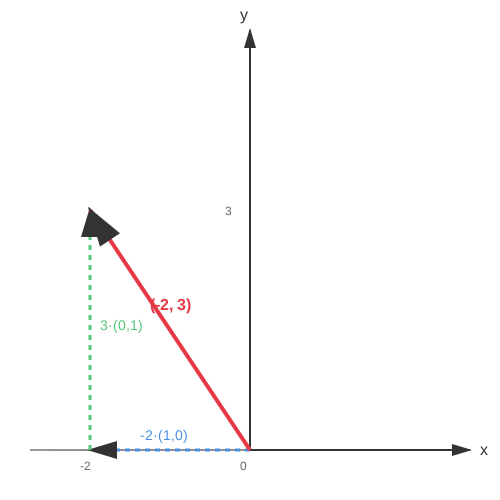
These are called basis vectors - the building blocks for all arrows in the plane. Any arrow $(a, b) = a \cdot (1, 0) + b \cdot (0, 1)$.
Multiplying the Basis Vectors
Let's apply our multiplication rule to the basis vectors:
$(1, 0) \times (1, 0)$: Length $1 \times 1 = 1$, angle $0° + 0° = 0°$, so $(1, 0) \times (1, 0) = (1, 0)$
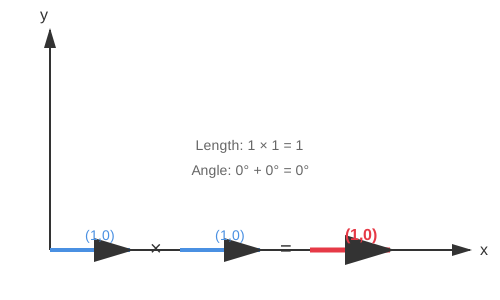
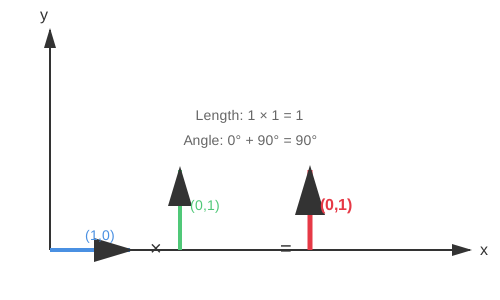
$(1, 0) \times (0, 1)$: Length $1 \times 1 = 1$, angle $0° + 90° = 90°$, so $(1, 0) \times (0, 1) = (0, 1)$
Now the interesting one - $(0, 1) \times (0, 1)$:
Length: $1 \times 1 = 1$
Angle: $90° + 90° = 180°$
An arrow at 180° with length 1 points directly along the negative x-axis. That's the vector $(-1, 0)$.
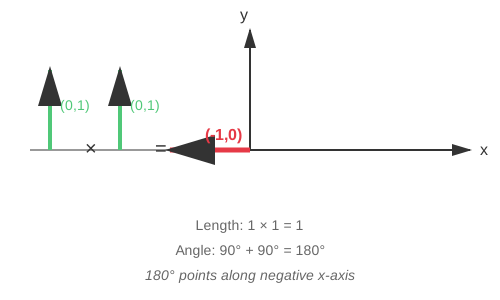
So when we multiply the vector $(0,1)$ by itself, we get the vector $(-1, 0)$ - a 90° rotation to the negative x-axis. In other words:
$$(0, 1) \times (0, 1) = (-1, 0)$$
Since $(-1, 0) = -1 \cdot (1, 0)$ and $(1,0)$ is just the number $-1$ (arrows along the x-axis are real numbers), we can write:
$$(0, 1)^2 = -1$$
The Reveal: What is $i$?
We just discovered that $(0,1)$ squared equals $-1$:
This is the defining property of $i$. The arrow $(0, 1)$ in $\mathbb{R}^2$, under the multiplication rule we constructed, satisfies $i^2 = -1$.
The arrow $(0, 1)$ IS the imaginary unit $i$.
Complex numbers aren't mystical objects - they can be represented as arrows in 2D with a multiplication operation we built by extending the pattern from $\mathbb{R}^1$.
Every arrow can be written as $(a, b) = a \cdot (1, 0) + b \cdot (0, 1)$. Since $(1,0) \times (a, b) = (a, b)$ - it's the multiplicative identity - we can write:
$$a \cdot (1, 0) + b \cdot (0, 1) = a + b \cdot (0, 1)$$
Replacing $(0, 1)$ with $i$:
$$a + bi$$
This is standard complex notation. The number $3 + 4i$ is the arrow $(3, 4)$:
$$3 + 4i = 3 \cdot (1, 0) + 4 \cdot (0, 1) = (3, 4)$$
Completing the Picture
Complex numbers can be represented as ordered pairs in $\mathbb{R}^2$ with addition from the standard vector space structure and multiplication from the pattern we extended from $\mathbb{R}^1$ (multiply lengths, add angles).
Here are the operations in action:
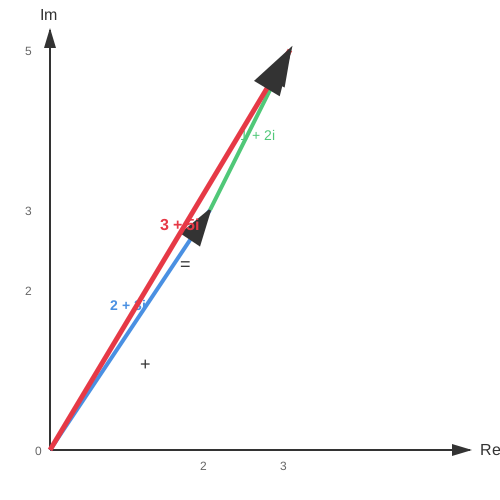
Adding Complex Numbers
$(2 + 3i) + (1 + 2i) = (2, 3) + (1, 2) = (3, 5) = 3 + 5i$
Multiplying Complex Numbers
$(2 + i) \times (1 + 2i) = (2, 1) \times (1, 2)$
Using $(a, b) \times (c, d) = (ac - bd, bc + ad)$:
$$= ((2)(1) - (1)(2), (1)(1) + (2)(2)) = (0, 5) = 5i$$
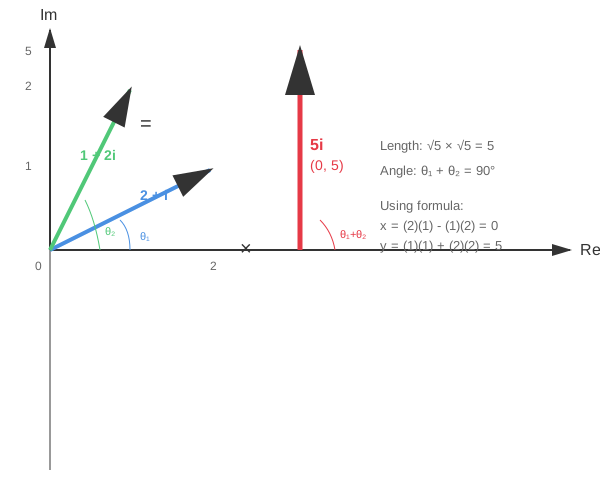
Algebraically:
$$(2 + i)(1 + 2i) = 2 + 4i + i + 2i^2 = 2 + 5i - 2 = 5i$$
The algebra follows from the geometric rule.
Final Word
Complex numbers $\mathbb{C}$ contain the real numbers $\mathbb{R}$ as a special case. Any real number $a$ is just $a + 0i = (a, 0)$ - an arrow along the x-axis. Operations on real numbers work the same way:
$$(3 + 0i) + (2 + 0i) = 5 + 0i = 5$$
$$(3 + 0i) \times (2 + 0i) = 6 + 0i = 6$$
We extended multiplication from $\mathbb{R}^1$ to $\mathbb{R}^2$, and complex numbers emerged naturally. The real numbers sit inside as arrows along the real axis.
We've seen that $i$ corresponds to the arrow $(0, 1)$ with the property that $i^2 = -1$. Complex numbers can be represented as 2D arrows with geometric multiplication - not a symbolic trick, but a natural extension of how real numbers work.
The deeper question remains: Why does the physical universe - electromagnetism, quantum mechanics, signal processing - use this exact mathematical structure? Why does nature compute with arrows in the plane?
That's for future posts. But now you know what $i$ really is: not an imaginary abstraction, but the arrow $(0, 1)$. Multiplying by $i$ rotates any arrow in the plane by 90 degrees.
On a Personal Note
Writing this post forced me to dig deeper than I expected, and I'm grateful for it. I didn't just relearn a fundamental concept - I learned something about learning itself. We take for granted what we're taught, treating these ideas as fixed truths rather than concepts to question and rebuild. $i$ isn't an imaginary abstraction - it has clear geometric meaning. So do many other ideas in math and science. It's worth stopping to question them, to rebuild them from scratch, to see what's really there.
Comments
Leave a Comment
Comments (0)